
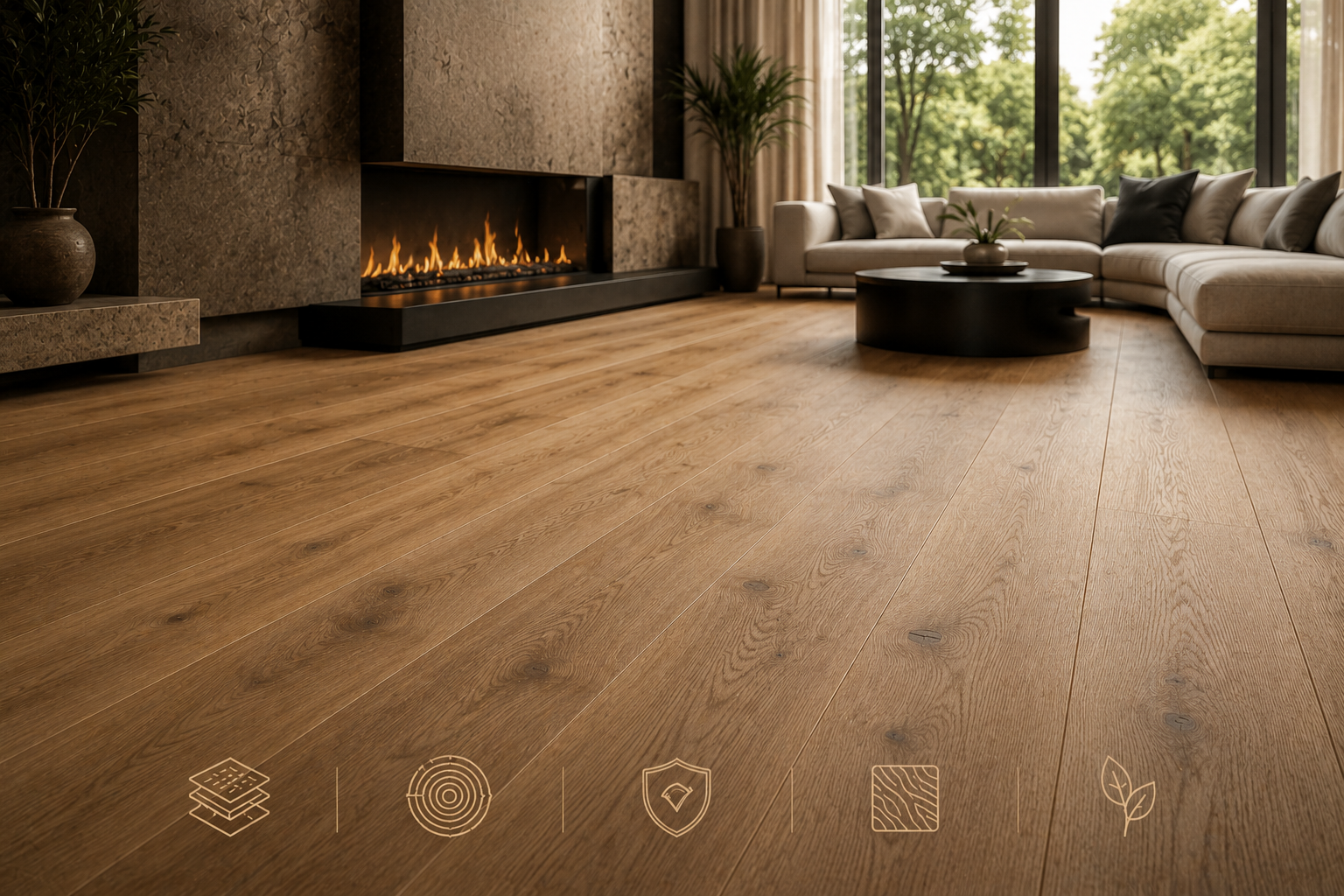
Beyond the Surface: Choosing Engineered Hardwood with Confidence
Engineered hardwood flooring in South Africa has become one of the most sought-after flooring choices for luxury homes, commercial interiors, hospitality projects, and high-end residential renovations. However, when comparing options, many buyers focus only on brand names and price tags when the true value lies beneath the surface.
For homeowners, interior designers, architects, retailers, and specifiers, comparing engineered wood flooring in South Africa requires an apples-for-apples approach.
Two planks may look nearly identical in a showroom, yet perform entirely differently once installed depending on construction, grading, veneer thickness, manufacturing quality, finish, and installation method.
This comprehensive guide explains the real differences between engineered hardwood flooring options so you can ask the right questions, compare products properly, and invest confidently.
What Is Engineered Hardwood Flooring?
Engineered hardwood flooring is made from a layer of real hardwood bonded to a stable structural core. Unlike solid hardwood flooring, which consists of a single piece of timber, engineered construction offers improved dimensional stability, making it more resistant to expansion and contraction caused by changes in humidity and temperature.
This makes engineered oak flooring particularly suitable for South African conditions, where seasonal climate variation can impact natural wood.
The Anatomy of the Plank: Construction & Core
The foundation of any engineered hardwood floor lies beneath the surface. Core construction directly impacts dimensional stability, long-term durability, installation performance, and overall value.
3-Ply (3-Layer) Engineered Hardwood
A 3-ply engineered hardwood floor consists of three carefully engineered layers designed to create structural stability while maintaining the beauty of real oak.
Authentic hardwood wear layer delivering the natural beauty and character of real timber.
Typically spruce, pine, or poplar laid cross-grain to improve stability and reduce natural movement.
Balances the plank structure to enhance long-term performance and dimensional integrity.
Why It Performs Well
This construction is efficient, cost-effective, and performs exceptionally well in standard residential applications where dependable stability and authentic timber aesthetics are essential.
Key Benefits
- Excellent dimensional stability
- Reliable long-term performance
- Efficient manufacturing construction
- Strong durability for residential use
Multi-Ply Engineered Hardwood
Multi-ply engineered hardwood consists of multiple layers of plywood, typically seven to nine plies, bonded together in alternating grain directions.
This cross-ply structure provides exceptional structural integrity, making it a strong option for technically demanding interiors where stability is essential.
Common Core Materials
- Birch plywood
- Eucalyptus plywood
Recommended For
- Underfloor heating applications
- Large open-plan interiors
- Commercial spaces
- Areas with significant temperature fluctuations
Veneer Thickness and Total Thickness: 14/3 vs 15/4 Engineered Hardwood
One of the most important comparisons in the South African engineered wood flooring market is 14/3mm vs 15/4mm engineered hardwood.
The top oak veneer also known as the wear layer directly affects lifespan, refinishing potential, and overall value.
14/3mm Engineered Hardwood Flooring
- 14mm total thickness
- 11mm structural core
- 3mm solid oak veneer
This is considered the industry standard and offers excellent long-term durability.
A 3mm wear layer can typically be professionally sanded and refinished one to two times, depending on sanding depth and floor condition.
Best suited for:
- Residential applications
- Standard specification projects
- Cost-conscious premium buyers
15/4mm Engineered Hardwood Flooring
- 15mm total thickness
- 11mm core
- 4mm solid oak veneer
This represents a premium upgrade.
Advantages include:
- Greater lifespan
- Two to three professional refinishes
- Better acoustic performance
- More substantial underfoot feel
- Enhanced premium perception
For long-term specification, 15/4 engineered oak flooring is often the preferred choice.
Sawn Oak vs Sliced Oak: Understanding Veneer Quality
Not all engineered hardwood veneers are created equally.
One of the most overlooked comparisons is sawn oak vs sliced oak veneer construction.
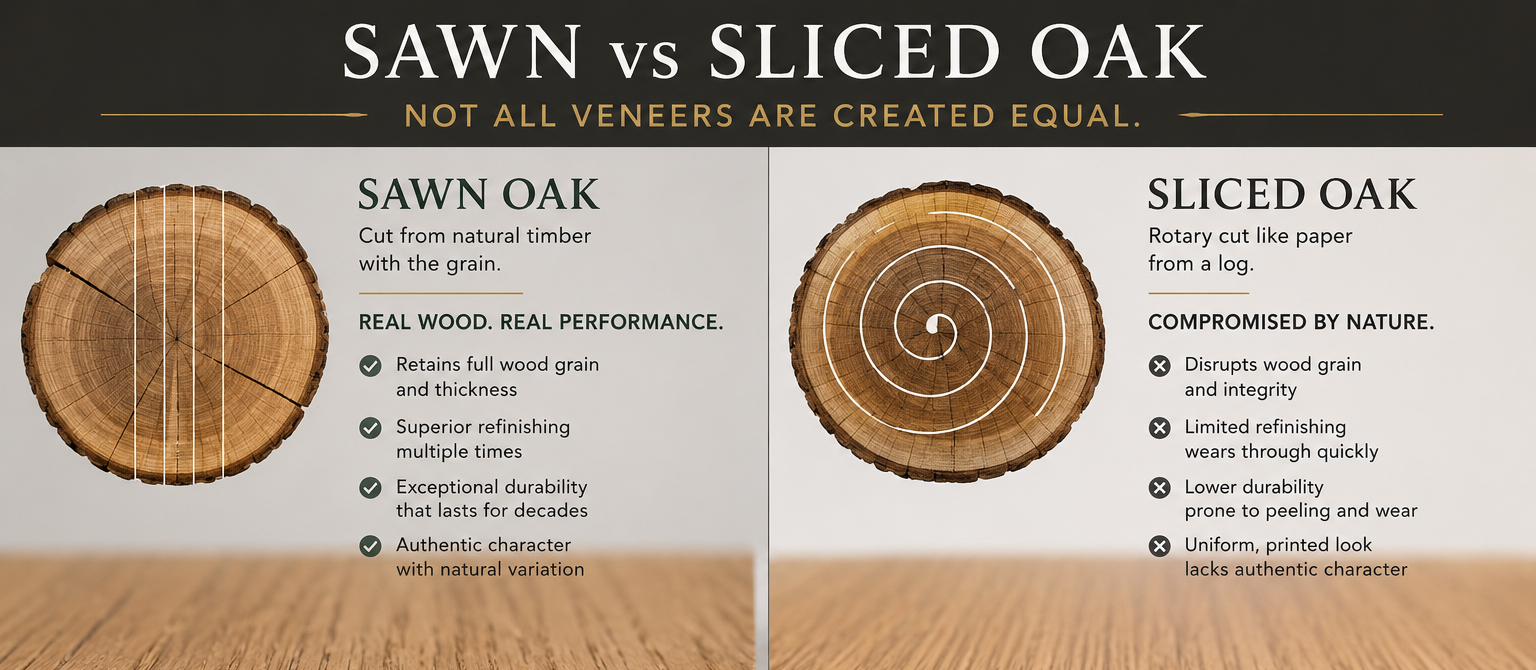
Sliced Oak vs Sawn Oak Veneers
Not all engineered hardwood veneers are created equally. While two floors may appear similar at first glance, the way the oak veneer is cut dramatically impacts durability, refinishing potential, and long-term performance.
Sliced Oak Veneers
Sliced veneers are created through a high-efficiency manufacturing process.
How It’s Made
- Boiling or steaming the log
- Softening the timber
- Pressing against a stationary blade
- Producing thin veneer sheets
Advantages
- Lower manufacturing cost
- Less waste
- Higher yield efficiency
Potential Limitations
- Typically thinner (1.5mm–2.5mm)
- More fragile
- Less suitable for repeated sanding
- Boiling may alter natural timber colour
- Microscopic fractures in grain structure
While sliced veneers are common in lower-cost products, they may compromise long-term performance.
Sawn Oak Veneers
Sawn veneers are cut using traditional saw blades for maximum structural integrity.
This Process Produces
- Genuine timber texture
- Natural grain authenticity
- Superior structural integrity
Advantages
- Typically 3mm–6mm thickness
- Better refinishing potential
- Greater dimensional stability
- No boiling process
- Retains natural timber colour
- Behaves like solid wood
For discerning buyers, architects, and specifiers, sawn engineered oak flooring remains the preferred standard.
European Oak vs Russian Oak vs Chinese Manufactured Flooring
When comparing engineered hardwood flooring, the word oak alone does not tell the full story. Timber origin and manufacturing origin both influence final quality.
European Oak
European Oak, primarily Quercus robur and Quercus petraea, is widely considered the premium benchmark in engineered hardwood flooring.
- Slow growth
- Tighter grain
- Higher density
- Greater hardness
- Rich tannin content
- Excellent staining responsiveness
- Beautiful fuming potential
Russian Oak
Russian oak is generally the same species, Quercus robur, but grown in Eastern Europe and Russia.
- Slightly faster growth
- Marginally lower density
- Lower tannin levels
- Straighter grain patterns
- Strong value proposition
Chinese Manufactured Engineered Hardwood Flooring
“Chinese oak” often refers to manufacturing origin rather than timber species. Many Chinese factories import European oak, Russian oak, or American oak to manufacture engineered flooring.
Top-tier factories may use:
- German machinery
- Premium finishing systems
- Strict quality control
- High-grade construction methods
Lower-tier factories may compromise on:
- Veneer thickness
- Core materials
- Finishing consistency
- Manufacturing precision
Engineered Hardwood Grading Explained
Wood grading affects visual character, not structural performance. A rustic engineered oak floor is not weaker than a prime grade floor. Grade selection is purely aesthetic.
Prime Grade
Characteristics
- Very few small knots
- Minimal colour variation
- Minimal sapwood
- Clean uniform appearance
Best For
- Luxury contemporary interiors
- Minimalist spaces
- High-end architectural projects
Select Grade
Characteristics
- Small to medium knots
- Moderate variation
- Balanced natural character
Best For
- Transitional interiors
- Refined residential spaces
Natural Grade
Characteristics
- Frequent knots
- Visible gum veins
- Filled checks
- Strong natural variation
Best For
- Coastal interiors
- Classic homes
- Natural warm aesthetics
Rustic Grade
Characteristics
- Prominent knots
- Sapwood streaks
- Heavy variation
- Strong character
Best For
- Farmhouse interiors
- Industrial design
- Textured statement spaces
Extra Rustic
Characteristics
- Large open knots
- Splits
- Heavy grain variation
Best For
- Heritage-inspired interiors
- Specialist rustic projects
Performance, Installation & Long-Term Value
Beyond construction and timber origin, finish systems, installation methods, manufacturing expertise, and technical support all play a critical role in how engineered hardwood performs over time.
Surface Finishes: UV Lacquer vs Oil vs Invisible Protect
UV Lacquered Engineered Hardwood
Factory-applied UV lacquer creates a hardened protective barrier.
Advantages- Highly scratch resistant
- Easy to clean
- Good water resistance
- Low maintenance
- Less natural tactile feel
- Harder to spot repair
- Full sanding often required for major repairs
Oiled Engineered Hardwood Floors
Oil penetrates into the timber rather than sitting on top.
Benefits- Natural tactile texture
- Authentic timber feel
- Warm appearance
- Spot repair capability
- Breathable finish
- More maintenance
- Periodic re-oiling required
- Specific cleaners needed
Invisible Protect / UV Oil
This hybrid finish combines the natural look of oil with factory-cured durability.
- The natural look of oil
- Factory-cured durability
- Ultra-matte appearance
- Reduced maintenance
Click vs Tongue and Groove Engineered Flooring
Tongue and Groove (T&G)
Traditional profile requiring glue-down installation or secret nailing.
Benefits- Rigid installation
- Professional-grade stability
- Preferred for premium installations
Click System Engineered Flooring
Modern locking systems include Uniclic and 5G click systems.
Benefits- Faster installation
- DIY friendliness
- Floating installation capability
- Secure locking
Floating vs Glue Down Installation
Floating Installation
Planks are installed over underlay without bonding to the subfloor.
Advantages- Faster
- Cleaner
- Lower labour cost
- Easier board replacement
- Hollow underfoot feel
- More movement
- Expansion profiles often required
Glue Down Installation
Planks are bonded directly to the subfloor using a specialised flexible wood adhesive.
Advantages- Premium solid feel
- Better acoustic performance
- Reduced footfall sound
- Greater installation continuity
- Fewer transition profiles
Why Manufacturer & Distributor Matter
Why Manufacturer Specialisation Matters
Not all flooring factories are equal. Ask whether the manufacturer specialises exclusively in engineered hardwood flooring.
Specialist manufacturers often deliver:- Better consistency
- Superior finishing
- Tighter tolerances
- Stronger product development
- Higher technical expertise
Why the Distributor Matters
The distributor plays a critical role in long-term satisfaction.
- Technical installation guidance
- Moisture testing support
- Subfloor recommendations
- Warranty assistance
- Product knowledge
- Long-term aftersales support
Before Choosing Engineered Hardwood Flooring in South Africa, Ask:
- Is the core 3-ply or multi-ply?
- What is the total thickness and veneer thickness?
- Is the veneer sawn or sliced?
- What is the oak origin?
- Where is the flooring manufactured?
- What grade is the timber?
- What finish is applied?
- Is the profile click or tongue and groove?
- Will the floor float or be glued down?
- Does the manufacturer specialise in engineered flooring?
- Does the distributor have a strong technical track record?
Move Beyond the Surface
To many buyers, oak is simply oak. But to architects, designers, retailers, and informed homeowners, the differences are substantial.
The best engineered hardwood flooring is not defined by branding alone. It is defined by construction, craftsmanship, technical performance, and long-term support.
By comparing engineered wood flooring properly, you move beyond showroom appearances and make a specification decision that delivers beauty, durability, and lasting value for decades.