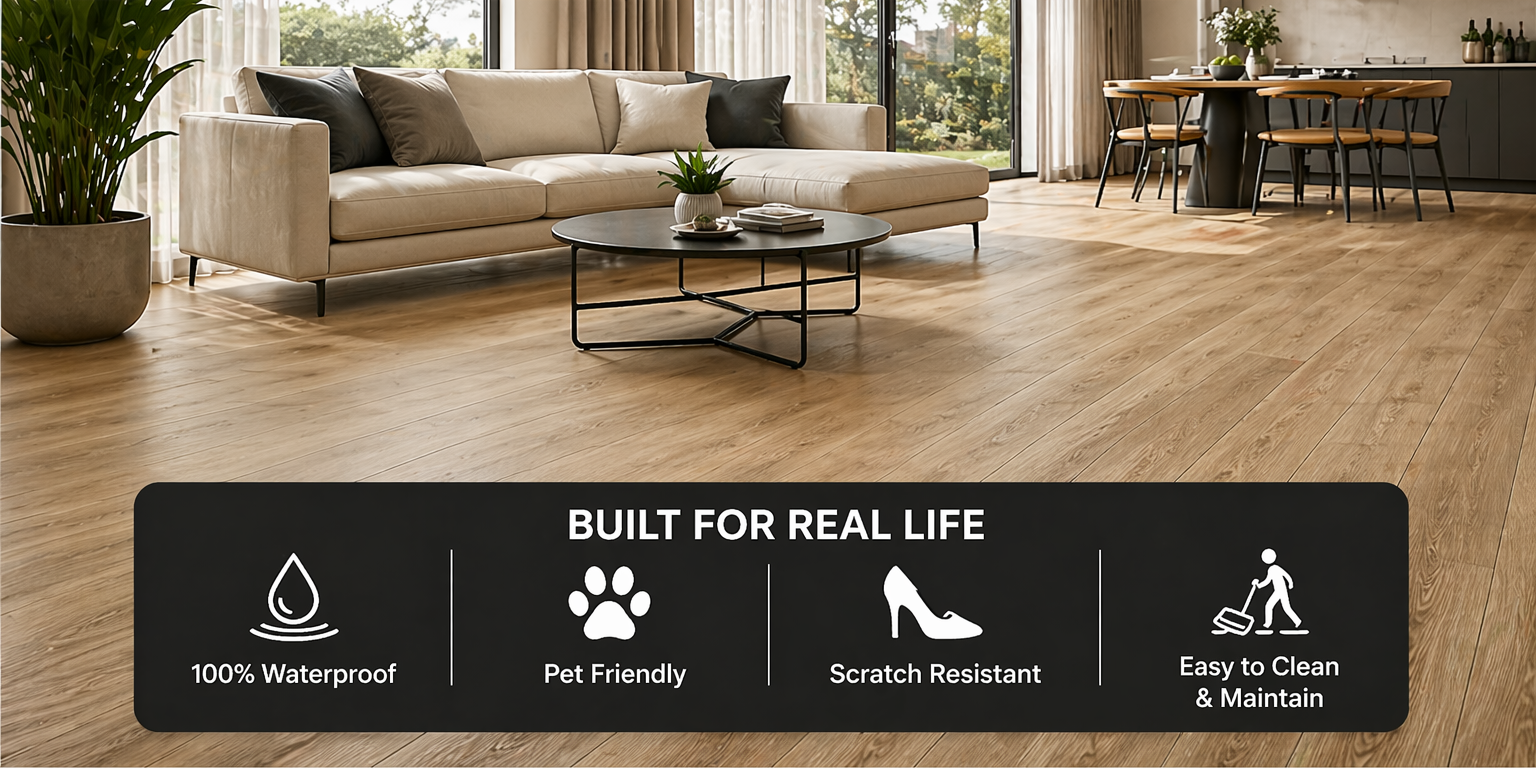
When specifying or selecting Luxury Vinyl Tile (LVT) flooring, one of the most important and often overlooked factors is the type of material used in its construction.
Should you choose virgin vinyl or recycled-content vinyl?
While both options exist in the market, understanding the technical differences can help architects, designers, and homeowners make more informed decisions especially when long-term performance, stability, and indoor air quality matter.
At FINfloor, we evaluate vinyl flooring not only by material type, but by overall construction, durability, and real-world performance.
What Is Virgin vs Recycled Vinyl?
Virgin vinyl is made from new, first-generation raw materials. Its composition is carefully controlled during manufacturing, resulting in consistent and predictable performance.
Recycled vinyl, on the other hand, incorporates post-industrial or post-consumer materials. While this can support sustainability goals, the quality and consistency of the material depend heavily on how it is processed and refined.
1. Material Consistency & Quality Control
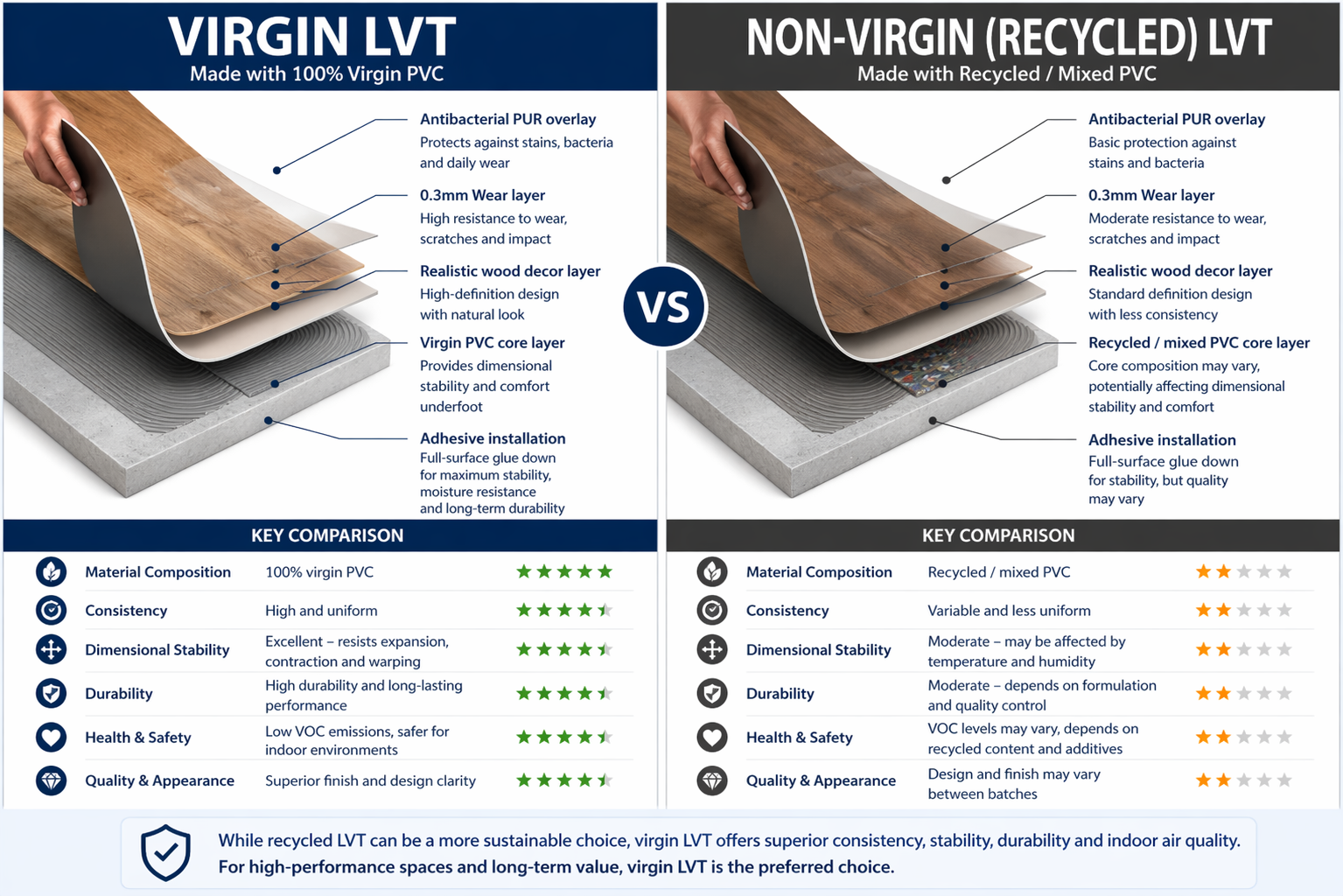
One of the biggest advantages of virgin vinyl is consistency.
Because it is produced from controlled raw materials:
- Properties remain uniform across batches
- Performance is predictable
- Manufacturing quality is easier to maintain
Recycled vinyl can vary depending on its source. Even though reputable manufacturers implement strict quality controls, inconsistencies in raw materials can make formulation more complex.
Why it matters:
Consistency directly impacts how the floor performs over time especially in demanding residential and commercial environments.
2. Dimensional Stability: Why It Matters
Dimensional stability refers to how well a floor resists:
- Expansion and contraction
- Warping or movement
- Gapping between planks
LVT manufactured with highly controlled raw materials typically offers more predictable dimensional stability, reducing the risk of movement over time.
This is particularly important in:
- Areas with temperature fluctuations
- Spaces with direct sunlight
- High-traffic commercial environments
That said, dimensional stability is influenced by more than just raw material. It also depends on:
- Product construction (SPC, glue-down LVT, click systems)
- Core technology
- Installation conditions
3. Durability & Long-Term Performance
Virgin vinyl is often used in premium LVT ranges because it supports:
- Consistent density
- Improved flexibility
- Strong wear performance
- High-quality surface finishes
Recycled-content LVT can still perform well, but this depends on:
- Manufacturing standards
- Product engineering
- Quality assurance processes
Key takeaway:
Durability is driven by the overall product design not just whether the material is virgin or recycled. However, virgin material allows for tighter control and consistency.
4. Health, Safety & Indoor Air Quality
Indoor air quality is a critical consideration in both residential and commercial spaces.
Rather than focusing only on material type, it’s important to look for:
- Low VOC emissions
- Third-party certifications (such as FloorScore® or equivalent)
- Compliance with international standards
In lower-quality products, inconsistent recycled content may introduce unknown additives. This is why certified, well-tested flooring is essential, regardless of composition.
Modern, well-manufactured LVT whether virgin or recycled can meet strict indoor air quality requirements when properly tested.
5. Sustainability Considerations
Recycled materials are often associated with sustainability — and rightly so.
However, sustainability in flooring should be evaluated holistically, including:
- Product lifespan
- Durability and replacement cycles
- Manufacturing standards
- Certifications and compliance
- Responsible sourcing
A longer-lasting floor that performs well over time can often be the more sustainable choice.
Virgin vs Recycled LVT: Quick Comparison
| Feature | Virgin LVT | Recycled LVT |
|---|---|---|
| Material Consistency | High | Variable |
| Manufacturing Control | High | Dependent on processing |
| Dimensional Stability | More predictable | Product-dependent |
| Durability | Premium-level consistency | Varies by manufacturer |
| Indoor Air Quality | Certification-dependent | Certification-dependent |
| Sustainability | Longer lifespan | Supports material reuse |