
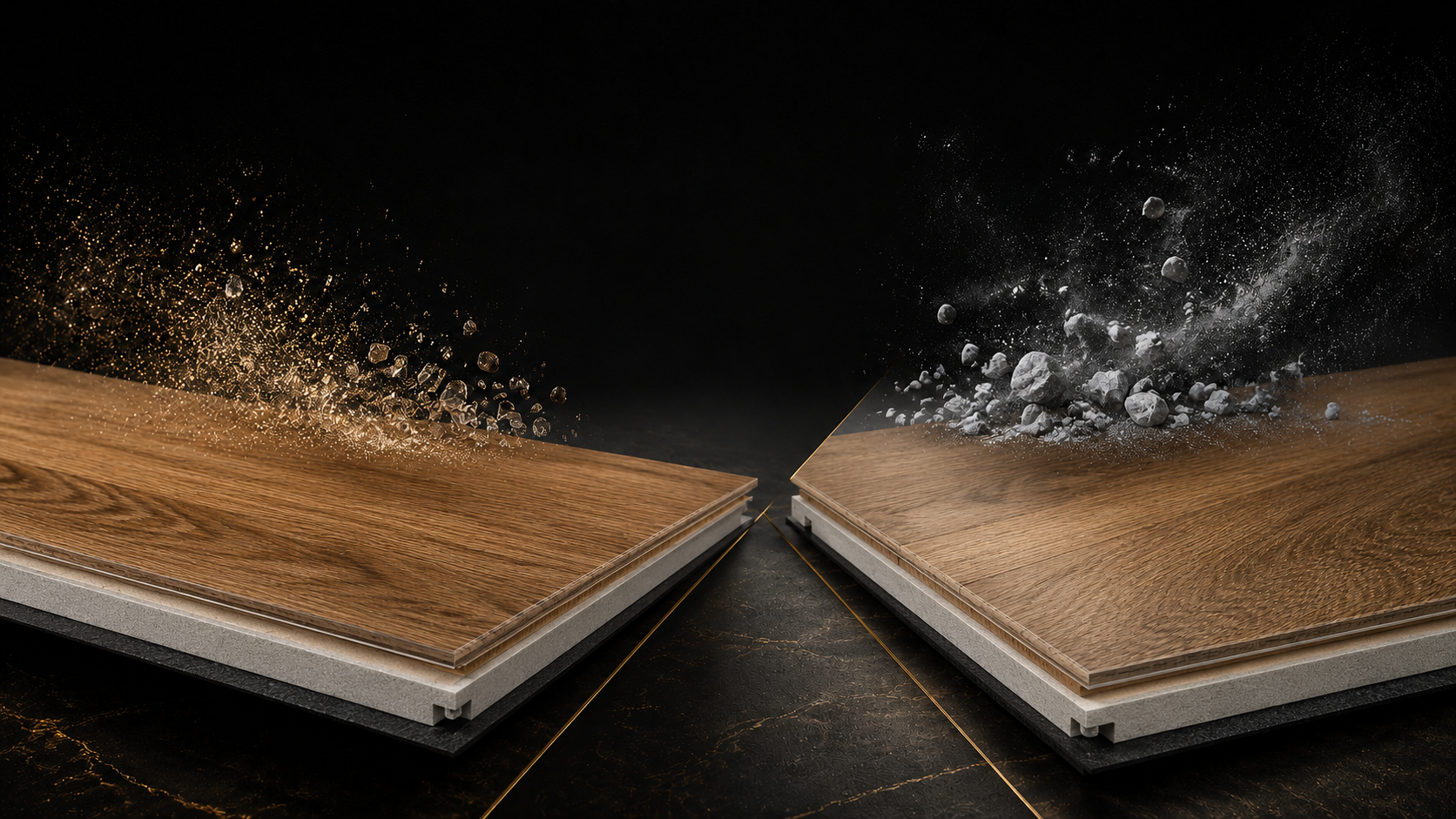
SPC Flooring Technology
Ceramic Bead vs Aluminium Oxide: Which SPC Flooring Finish Performs Better?
A practical comparison of two leading protective coating technologies applied to the same commercial-grade 0.5 mm (20 mil) SPC wear layer.
Executive summary
When selecting Stone Plastic Composite (SPC) vinyl flooring, the wear layer and protective coating play an important role in durability, appearance retention and scratch resistance.
Neither technology is universally superior. Ceramic bead with double-UV coating excels at resisting continuous surface abrasion and everyday micro-scuffing, while aluminium oxide offers slightly better resistance to deep, concentrated point scratches.
How an SPC floor is constructed
Select a layer below to see the role it plays in the finished floor.
1. Material composition and hardness
The minerals embedded in the polyurethane coating influence how the surface responds to abrasion, friction and concentrated pressure.
Ceramic bead (silicon carbide)
In flooring applications, ceramic bead technology commonly uses microscopic silicon carbide (SiC) particles within a UV-cured polyurethane coating.
- Hardness: Approximately 9.5 on the Mohs scale.
- Key property: Exceptional resistance to cutting, friction and surface abrasion.
- Application: A double-UV process helps create a stable surface with enhanced stain, slip and wear resistance.
Aluminium oxide (Al2O3)
Aluminium oxide is an established hard-mineral finish used extensively in premium laminate and luxury vinyl flooring.
- Hardness: Approximately 9.0 on the Mohs scale.
- Key property: Slightly softer than silicon carbide, but generally tougher and less brittle under point pressure.
- Performance: Its toughness helps it withstand concentrated loading before a visible scratch forms.
DECNO comparative laboratory testing
The results in one view
Two controlled tests assessed different types of surface damage. The pin-type test measured resistance to concentrated scratching, while the Martindale test measured repeated surface abrasion at 38 N and 160 rpm.
Aluminium oxide
Minor scratching first appeared at the higher point load, compared with 3,100 g for silicon carbide.
Silicon carbide
Passed the Martindale abrasion test, while the aluminium oxide sample showed visible scratching and continuous wear patterns.
Source: DECNO Test UV Coating comparative test sheet supplied to FINfloor. Note: the source sheet labels 3,500 g as 30 N; the standard mass-to-force conversion is approximately 35 N, which is used in the table below.
2. Detailed performance comparison
A. Point-scratch resistance
A pin-type scratch test simulates concentrated pressure from sharp objects, furniture legs, dropped items and pet claws.
| Surface finish | Applied load | Test result |
|---|---|---|
| Aluminium oxide | 2,500 g (25 N) | No scratches — pass |
| Aluminium oxide | 3,000 g (30 N) | No scratches — pass |
| Aluminium oxide | 3,500 g (35 N) | Minor scratches — fail |
| Silicon carbide | 2,500 g (25 N) | No scratches — pass |
| Silicon carbide | 3,000 g (30 N) | No scratches — pass |
| Silicon carbide | 3,100 g (31 N) | Minor scratches — fail |
Result: In the supplied DECNO laboratory data, aluminium oxide resisted the higher concentrated load before minor scratching occurred. This makes it the stronger performer against deep, point-type scratches.
B. Surface-abrasion resistance
The Martindale abrasion test, conducted at 38 N and 160 rpm, simulates repetitive wear caused by heavy foot traffic, sliding chairs and general scuffing over time.
| Surface finish | Observation | Result |
|---|---|---|
| Aluminium oxide | Many visible scratches with slight continuous patterns | Fail |
| Silicon carbide | No visible scratches on the surface | Pass |
Result: In the supplied DECNO laboratory data, ceramic bead performed better against continuous surface abrasion. Its greater mineral hardness helps limit the micro-scuffing and dulling associated with repetitive friction.
Compare the performance areas
Point-scratch resistance
Advantage: Aluminium oxide. In the supplied test, it resisted the higher concentrated load before minor scratching appeared. Felt pads and correct furniture protection are still recommended.
Continuous surface abrasion
Advantage: Ceramic bead. The silicon carbide sample showed no visible scratches in the supplied Martindale test.
Best environment
Ceramic bead is compelling for busy circulation areas where appearance retention matters. Aluminium oxide suits spaces where concentrated scratching from movable furniture or large pets is the greater concern. Explore FINfloor’s commercial flooring solutions.
Care still matters
No coating makes a floor scratch-proof. Use suitable entrance mats, lift rather than drag furniture, fit protective pads and follow the applicable SPC and vinyl warranty guidance.
3. Longevity and the importance of wear-layer thickness
A floor’s service life is influenced by the combination of wear-layer thickness, protective finish, installation quality, traffic conditions and ongoing care. A 0.5 mm (20 mil) wear layer is commonly specified for premium residential and suitable commercial applications, including ranges such as FINfloor Diamond Core SPC+.
- 0.5 mm ceramic bead with double UV: Designed to resist micro-abrasion and help the floor retain its original visual finish in busy areas.
- 0.5 mm with aluminium oxide: May show surface micro-scratching sooner under repetitive friction, but its toughness provides strong protection against deeper, concentrated scratches.
4. Benefits at a glance
Choose ceramic bead with double UV for:
- High-traffic residential or commercial spaces
- Strong resistance to daily scuffs and micro-abrasion
- Long-term aesthetic and gloss retention
- Enhanced stain and UV protection
- A surface that is easy to maintain
Choose aluminium oxide for:
- Homes with large, active pets
- Areas with heavy furniture or sharp point loading
- Stronger resistance to deeper scratches and gouges
- A proven finish used across laminate and luxury vinyl
- Environments where concentrated impact is the main concern
So, which coating is superior?
For long-term appearance, reduced dull traffic paths and resistance to everyday scuffing, ceramic bead with double-UV coating is the stronger option.
For greater protection against deep gouges caused by sharp objects, heavy furniture legs or large pet claws, aluminium oxide has the advantage.
For a premium 0.5 mm SPC floor, ceramic bead double-UV technology offers a compelling modern solution to one of the most common flooring concerns: gradual dulling and micro-scuffing over time.
Frequently asked questions
No. Ceramic bead performed better in the supplied abrasion test, while aluminium oxide performed better under concentrated point loading.
Yes. Wear-layer thickness is an important part of the total specification, but it should be considered together with the coating, core, installation and warranty.
Aluminium oxide has the point-scratch advantage in the supplied test. However, nails should still be kept trimmed and suitable floor protection used in high-activity areas.
Explore related FINfloor resources
Compare FINfloor SPC and glue-down vinyl ranges. Diamond Core SPC+
View FINfloor’s premium commercial-grade SPC+ range. Sapphire SPC Wide
Explore wide-plank SPC with ceramic bead and double Super UV protection. SPC and vinyl warranty
Read the applicable installation and care requirements. Commercial flooring
Find flooring solutions for demanding commercial spaces. Find a store
Locate a FINfloor stockist or flooring specialist near you.
Need help choosing the right SPC flooring?
Explore FINfloor’s premium vinyl flooring ranges or speak to our team for practical product guidance.
Find a FINfloor Store