
Laminate vs Luxury Vinyl Tile: Commercial Flooring Durability Compared
A practical comparison of scratches, dents, moisture and commercial use
Which Flooring Is More Durable?
AC5 laminate generally offers better resistance to scratches and abrasion in dry, high-traffic commercial areas.
Commercial LVT with a 0.5 mm wear layer generally offers better moisture performance, impact flexibility and acoustic comfort.
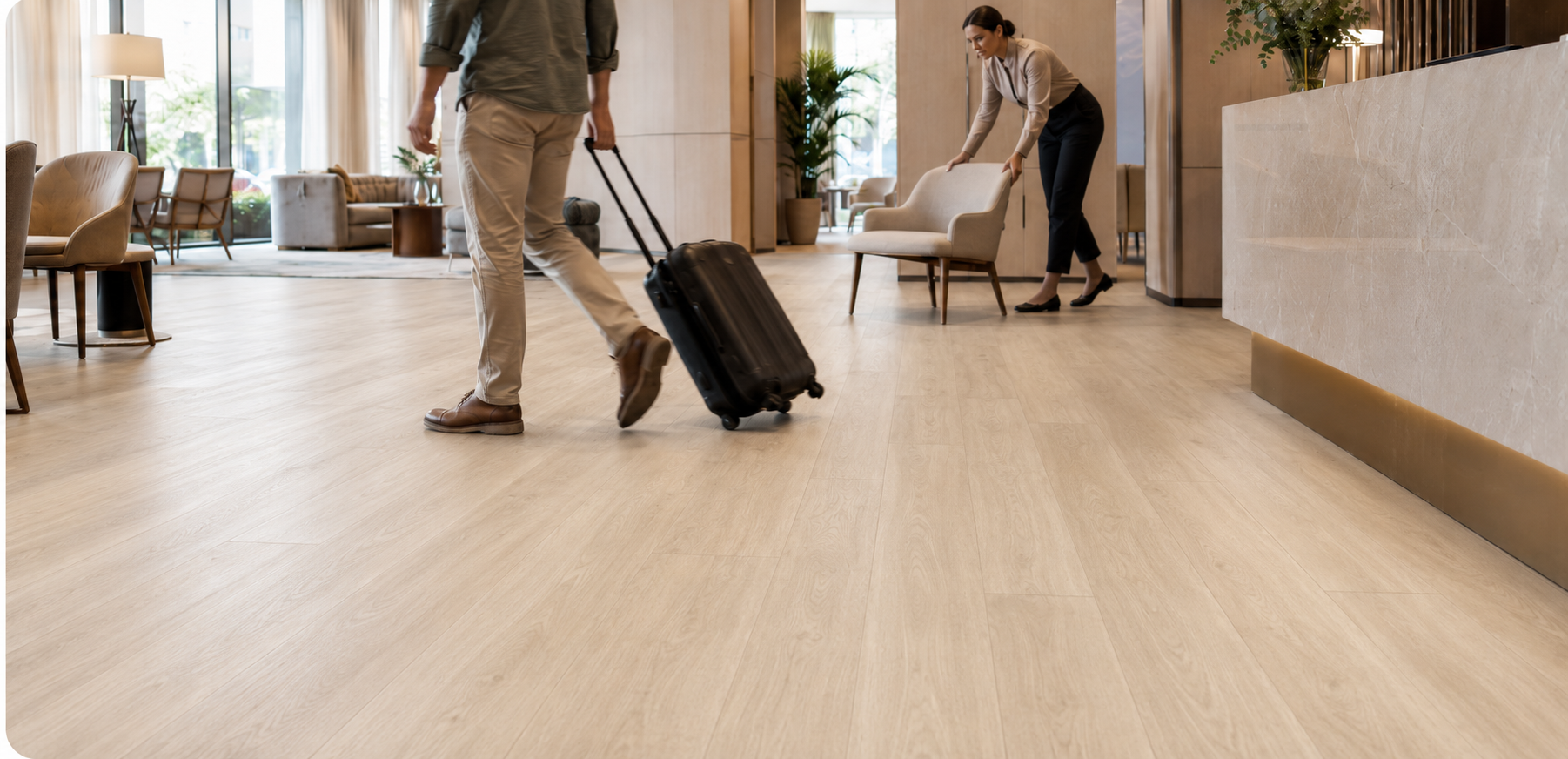
Commercial floors must withstand foot traffic, rolling luggage, furniture movement, grit, spills and frequent cleaning. The right choice depends on more than appearance.
Laminate and Luxury Vinyl Tile use different materials to protect their decorative surfaces. This affects how they react to scratches, impacts, moisture and long-term wear.
Laminate vs LVT at a Glance
| Performance Area | Commercial Laminate | Commercial LVT |
|---|---|---|
| Scratch resistance | Generally stronger | Good, depending on the coating |
| Impact flexibility | Hard and rigid | More flexible |
| Moisture performance | Depends on the product | Highly moisture-resistant |
| Acoustic comfort | Harder sound | Generally quieter |
| Heavy abrasive traffic | AC5 performs well | May develop micro-scratches |
| Wet-prone areas | Only where specifically approved | Usually more suitable |
How the Protective Surfaces Differ
Laminate Flooring
Laminate uses a hard, transparent melamine-resin overlay. This surface may be reinforced with aluminium oxide to increase resistance to abrasion and scratching.
The surface is rigid and well suited to tracked-in grit, rolling luggage and regular foot traffic.
Luxury Vinyl Tile
LVT uses a clear PVC wear layer over its decorative film. A UV-cured polyurethane coating provides additional resistance to stains, scuffs and everyday wear.
The vinyl construction is softer and more flexible than laminate.
Scratch Resistance vs Dent Resistance
Scratches and Abrasion
Laminate generally has the harder surface. It offers strong resistance to grit, rolling traffic and everyday scratching.
LVT is more flexible, but sharp objects and dragged furniture may leave scratches or gouges. Matt and textured finishes can help conceal fine surface marks.
Dents and Impacts
LVT can absorb certain impacts without chipping. However, heavy furniture and concentrated point loads may leave indentations.
Laminate resists many everyday indentations, but a heavy dropped object may chip the rigid surface or plank edge.
Direct Commercial Flooring Comparison
| Flooring | Typical Use | Main Strength | Main Limitation |
|---|---|---|---|
| AC4 laminate | General commercial | Strong scratch resistance | Requires careful moisture management |
| 0.3 mm LVT | Heavy residential or light commercial | Moisture-resistant and comfortable | Less suited to abrasive heavy traffic |
| AC5 laminate | Heavy commercial | Excellent abrasion resistance | Rigid surface can chip under severe impact |
| 0.5 mm LVT | Commercial | Moisture performance and flexibility | May develop micro-scratches over time |
AC4 Laminate vs 0.3 mm LVT
AC4 laminate generally provides better resistance to abrasive grit and everyday scratching. A 0.3 mm LVT wear layer is better suited to lighter commercial environments where moisture resistance and comfort are more important.
AC5 Laminate vs 0.5 mm LVT
AC5 laminate generally provides the harder, more scratch-resistant surface. Commercial LVT with a 0.5 mm wear layer offers better flexibility and moisture performance.
Which Floor Should You Choose?
Choose Commercial Laminate When:
- Scratch and abrasion resistance are priorities.
- The environment is dry and climate-controlled.
- Rolling luggage or tracked-in grit is expected.
- A hard, rigid surface is preferred.
- The product is approved for the expected traffic.
Choose Commercial LVT When:
- Moisture resistance is important.
- A quieter floor is required.
- Spills and frequent cleaning are expected.
- Impact flexibility is valued.
- The area includes hospitality or food service.
Hotel Lobbies and Busy Dry Areas
AC5 laminate is a strong option where abrasion from grit, footwear and rolling luggage is the main concern.
Bathrooms, Kitchens and Moisture-Prone Areas
Commercial LVT with a 0.5 mm wear layer is generally more practical where moisture and frequent cleaning are expected.
Hotel Rooms and Moderate Commercial Areas
Both AC4 laminate and suitably rated LVT can perform well. Consider moisture, acoustics, comfort and the expected level of traffic.
Frequently Asked Questions
Is laminate more scratch-resistant than LVT?
Laminate generally has the harder surface and provides stronger resistance to scratching and abrasive grit. LVT is more flexible but may develop fine scratches more easily.
Is 0.5 mm LVT suitable for commercial use?
A 0.5 mm wear layer is commonly used in commercial LVT. Suitability still depends on the complete specification, coating, installation method and manufacturer’s approved-use rating.
What is the difference between AC4 and AC5 laminate?
AC4 is generally used for general commercial applications. AC5 is intended for heavier commercial traffic.
Which floor is better for hotel rooms?
Both may be suitable. Laminate offers strong scratch resistance, while LVT offers better moisture performance and acoustic comfort.
Does a thicker LVT wear layer prevent scratches?
Not necessarily. A thicker wear layer provides more material above the decorative film, but surface hardness also depends on the coating, texture, maintenance and use conditions.
Final Recommendation
Choose AC5 laminate for dry commercial environments where scratch and abrasion resistance are the main priorities.
Choose commercial LVT with a 0.5 mm wear layer where moisture resistance, flexibility and acoustic comfort are more important.
The final selection should always be based on the complete product specification and the requirements of the project.
Find the Right Commercial Floor
Explore FINfloor’s laminate and luxury vinyl collections or contact our team for assistance with your commercial flooring specification.
Explore FINfloor