
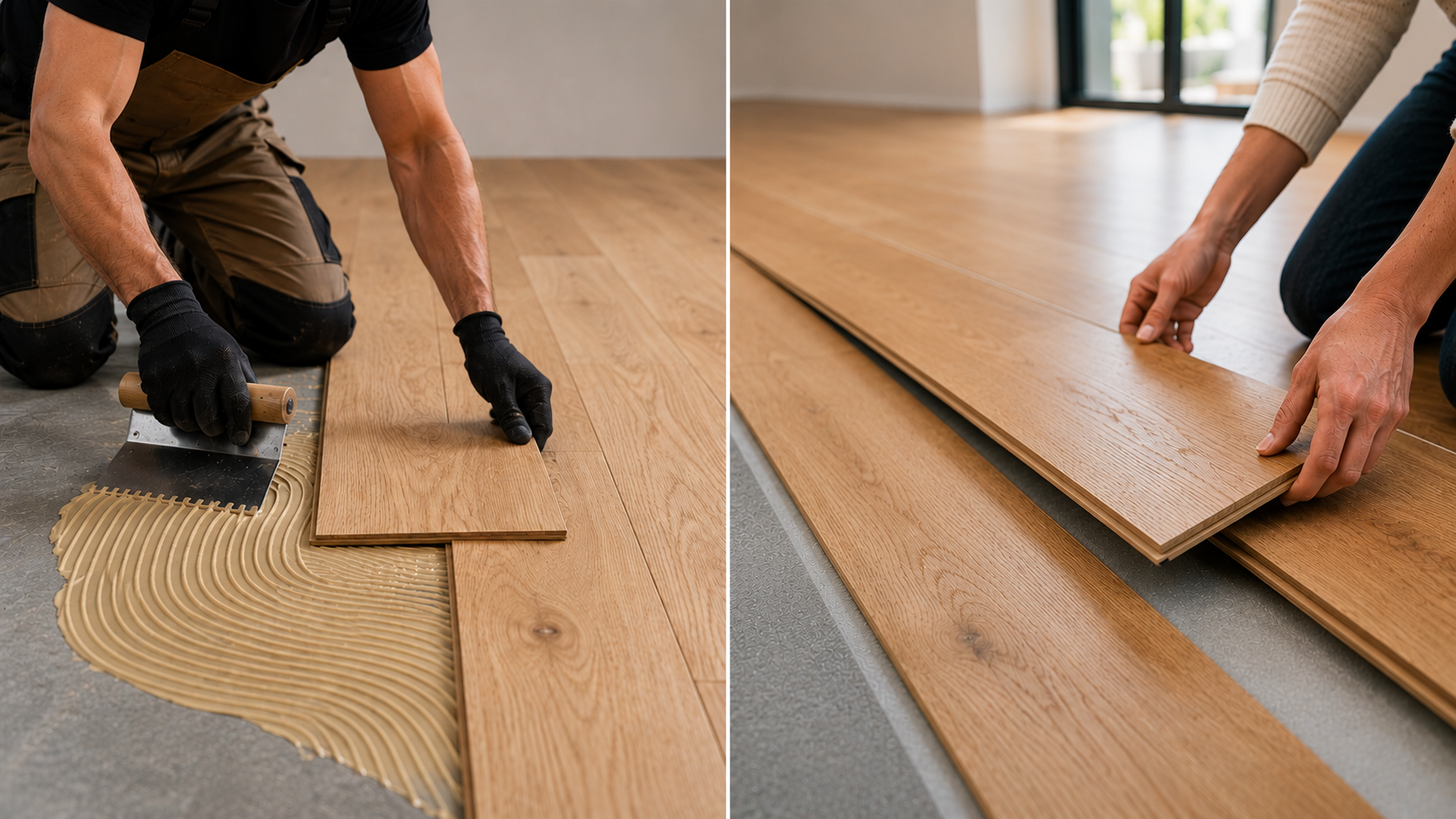
When investing in premium engineered hardwood flooring, the installation method you choose plays a critical role in the overall performance, longevity, and return on investment. A high-quality floor, when installed correctly, not only enhances the aesthetic of a space but ensures durability, stability, and long-term value. Proper installation protects your investment reducing maintenance costs, minimising future repairs, and extending the lifespan of what is often a significant financial outlay in a home or commercial project.
When it comes to click engineered hardwood flooring, there are two primary installation methods: floating and glue-down. Understanding the differences between these systems will help you make an informed decision that aligns with your budget, design intent, and performance expectations.
Understanding Click Engineered Flooring
Engineered hardwood flooring is constructed from multiple layers, with a real hardwood top layer bonded to a stable core (typically plywood or high-density fibreboard). This layered construction improves dimensional stability, making it less susceptible to moisture and temperature changes than solid wood.
Click systems, such as Välinge 5G, allow planks to lock together without nails or traditional fixing methods making installation faster and more efficient.
The Floating Installation Method
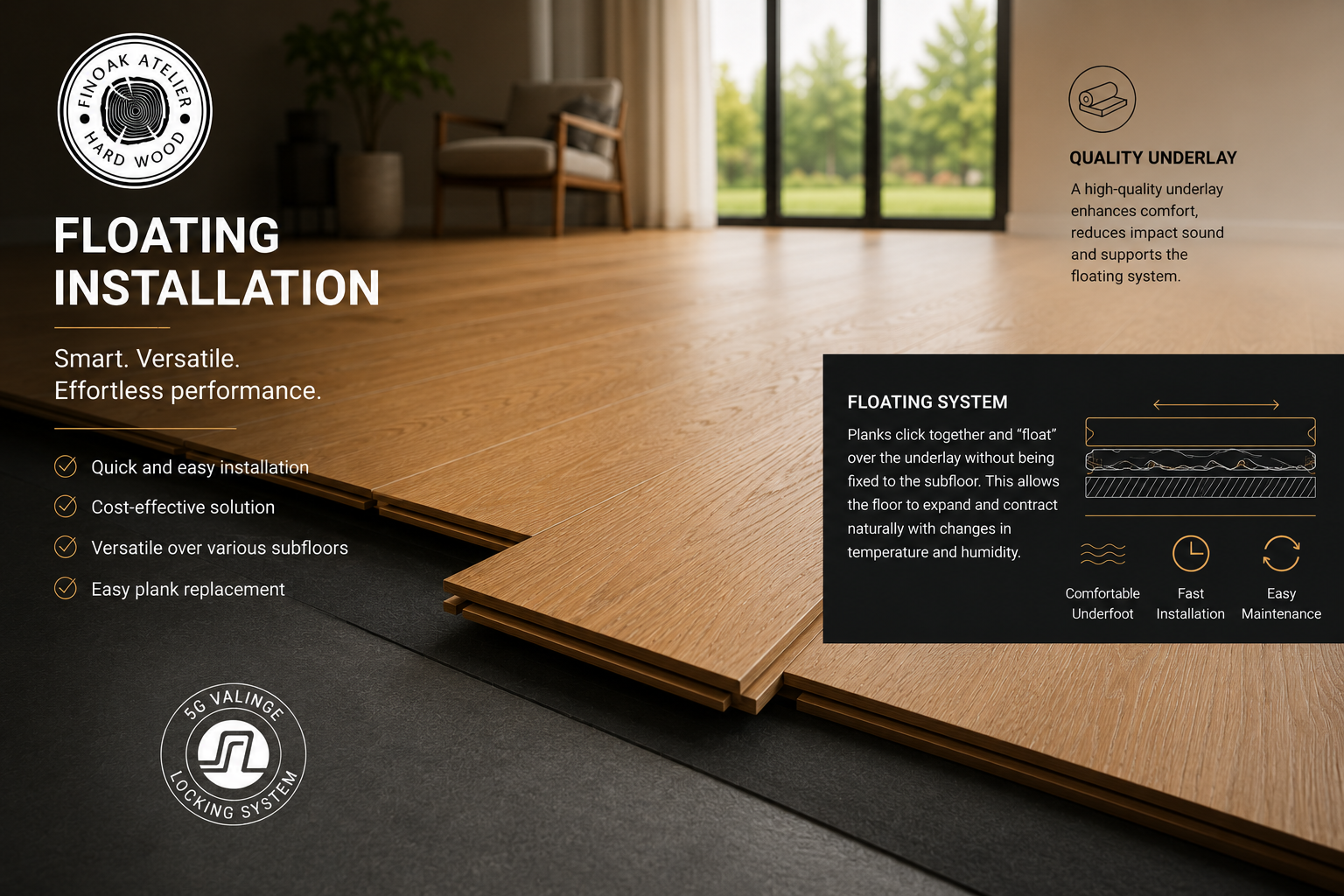
A floating floor is not fixed directly to the subfloor. Instead, the boards are connected to one another, forming a single “floating” surface above an underlay.
Benefits of Floating Floors
1. Quick and Efficient Installation
Floating floors are faster to install, making them ideal for time-sensitive projects or renovations.
2. Cost-Effective
Reduced labour time and no adhesive requirements make this a more budget-friendly option.
3. Versatility
Can be installed over various subfloors, including concrete, tiles, or existing flooring.
4. Easier Repairs
Damaged planks can be removed and replaced with minimal disruption.
Considerations
Floating floors may feel slightly hollow underfoot if the subfloor is not perfectly level. They also require expansion gaps and often transition profiles between rooms.
The Glue-Down Installation Method
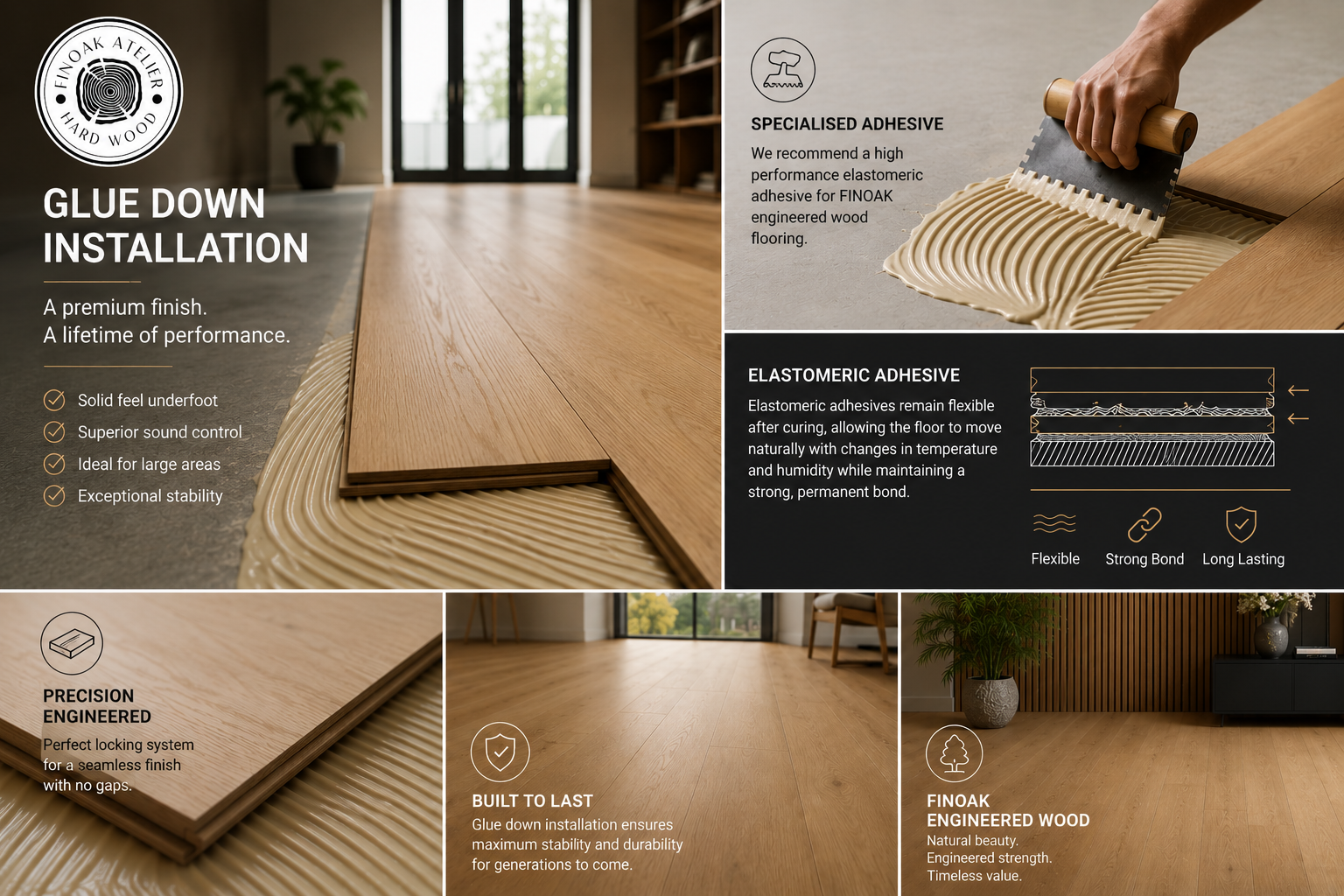
In a glue-down installation, each plank is adhered directly to the subfloor using a specialised adhesive typically an elastomeric adhesive.
What is an Elastomeric Adhesive?
The term elastomeric refers to the adhesive’s ability to remain flexible after curing. Unlike rigid adhesives, elastomeric adhesives can stretch and compress slightly without breaking their bond.
This flexibility is crucial in flooring because wood naturally expands and contracts with changes in temperature and humidity. An elastomeric adhesive:
- Absorbs movement within the wood, reducing stress on the boards
- Maintains a strong bond without becoming brittle over time
- Improves durability by preventing cracking or adhesive failure
- Enhances comfort and acoustics by creating a cushioned, stable connection
In simple terms, it allows the floor to “move naturally” while still being firmly secure done of the key reasons glue-down installations perform exceptionally well over time.
Benefits of Glue-Down Floors
1. Solid Feel Underfoot
Creates a firm, stable surface that closely replicates solid hardwood.
2. Superior Acoustic Performance
Reduces hollow sounds, resulting in a quieter, more premium feel.
3. Seamless Design
Allows for larger continuous installations without the need for doorway profiles or transition strips.
4. Increased Stability
Minimises movement, making it ideal for high-traffic areas and large open-plan spaces.
Considerations
Glue-down installations require:
- A perfectly level, clean, and dry subfloor
- Skilled installation (recommended for professionals)
- More time and higher upfront cost
Repairs can also be more complex, as planks are bonded directly to the subfloor.
Floating vs. Glue-Down: Key Differences
| Feature | Floating Installation | Glue-Down Installation |
|---|---|---|
| Installation Speed | Fast | Slower |
| Cost | More cost-effective | Higher upfront cost |
| Sound | Slightly hollow | Solid and quiet |
| Subfloor Tolerance | More forgiving | Requires precision |
| Transitions | Often required | Minimal to none |
| Repairability | Easier | More complex |
Conclusion
Choosing between floating and glue-down installation ultimately comes down to your priorities.
If you are looking for a cost-effective, quick solution with flexibility, floating floors are a strong option. However, if your focus is on long-term performance, premium feel, and maximising the return on your flooring investment, a glue-down installation offers clear advantages.
A properly installed engineered hardwood floor particularly using high-quality elastomeric adhesives ensures enhanced durability, reduced maintenance, and long-lasting performance. In a premium flooring application, the installation method is not just a technical decision; it is a critical factor in protecting and maximising your investment for years to come.